

How Artificial Intelligence Can Work for You


You cannot turn on a financial news channel or attend a conference these days without hearing about Artificial Intelligence (AI). Whether you are already using it or simply curious about what it means for your daily life and finances, this guide will help you understand the opportunity and how to approach it thoughtfully.
AI is unlikely to reshape our lives through a single dramatic moment. Instead, like electricity or the internet before it, it will quietly transform how we work, make decisions, and manage our time with small day-to-day improvements that compound significantly over the years ahead.

At its core, AI refers to software systems that can understand language, recognize patterns, generate content, and assist with complex tasks, all without being explicitly programmed for every scenario. The most accessible form today is the conversational AI assistant, sometimes called a Large Language Model (LLM). Tools like ChatGPT, Google Gemini, Microsoft Copilot, and Claude fall into this category.
For our clients, this matters because AI is rapidly becoming embedded in the tools you already use, from your email inbox to your bank's mobile app, and understanding how to leverage it can save meaningful time and help you make more informed decisions.
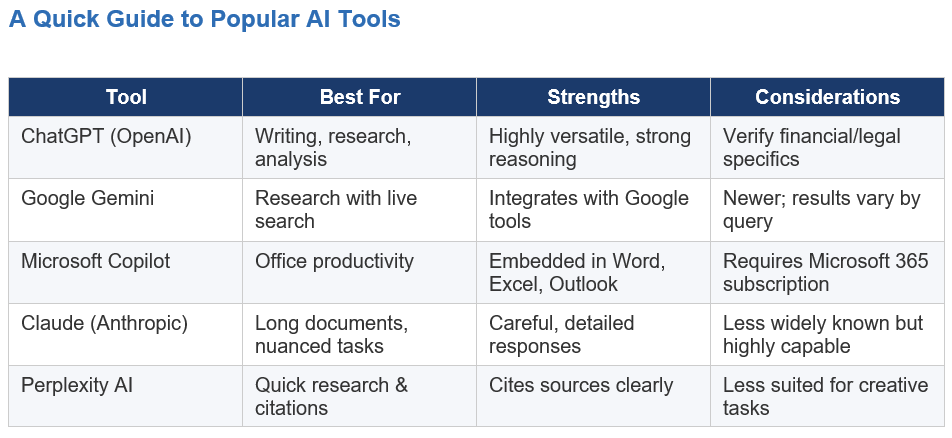

AI tools are only as useful as the instructions you give them. Unlike a search engine, where a few keywords suffice, AI works best when you have a real conversation with it. The quality of your question (called a "prompt") directly determines the quality of the response.

Use this simple three-part formula for better results:
- Role: Tell the AI who to act as: "Act as a financial educator..."
- Task: Tell it exactly what you want: "Draft a list of questions for my accountant..."
- Format: Tell it how to present the answer: "Respond in bullet points / Keep it under 200 words"


AI tools can be particularly valuable in helping you stay informed, organized, and prepared. We always recommend using these tools as a starting point for research, not a replacement for personalized professional advice.
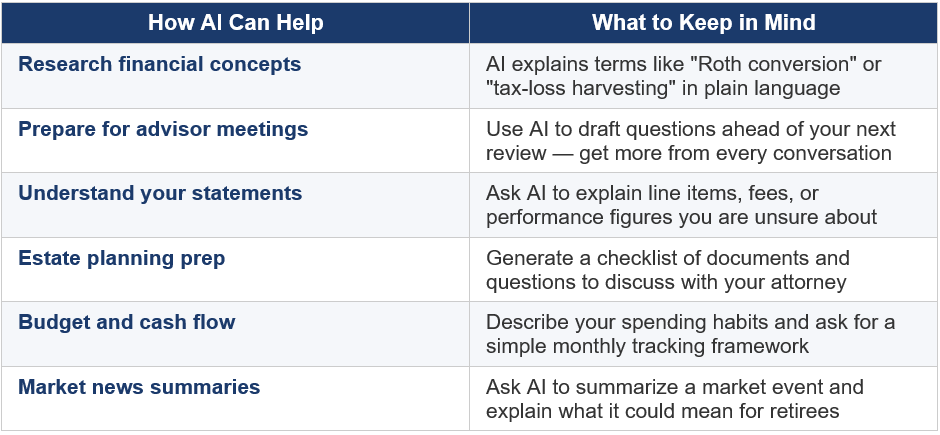

Some of the most satisfying uses of AI are the simplest. Here are a few examples our clients have found genuinely useful:
- Streaming services: Ask AI which platform carries a specific show and whether your current subscription tier includes it, saving time searching across apps
- Tech support: Copy an error message into an AI tool and ask for step-by-step troubleshooting instructions
- Email drafting: Describe a difficult email you need to send and ask AI to draft it professionally
- Travel planning: Ask AI to build a detailed itinerary, including restaurant options, for an upcoming trip
- Learning something new: Use AI to explain any topic, from Medicare options to solar panels, in terms suited to your background


We are genuinely in the early chapters of the AI era, and the pace of change is significant. Our firm monitors these developments carefully, both for the ways AI tools can enhance our service to you, and for the broader implications on your financial planning and estate considerations.
Our recommendation: start small. Pick one area of your life, such as researching a purchase, preparing for a meeting, or drafting a note, and try using an AI assistant. Most tools are free to start, require no technical knowledge, and improve rapidly with practice.
As always, we are here to help you navigate these changes. If you have questions about how AI might affect your financial planning, your estate, or your business interests, please do not hesitate to reach out.
